Number of players and substitutions
Each team may have six players on the field. Six substitutes may also be used. Substitutions take place at the halfway line.
Pitch, goal and goal area size
The original size of the pitch is 42 metres long and 21 metres wide. The game is played on mini goals that are three metres wide and one metre high. The goal area must be clearly marked. The size of the goal area is circular with a 3 metre radius and a width of 5 metres, similar to a throwing circle in handball. The size of the pitch or goal, the number of participants and the goal area can be adjusted depending on the pitch situation.
Playing time
As a rule, a game lasts ten to fifteen minutes, four times, with five-minute breaks. In tournaments, the playing time is twelve minutes once; this can be varied by the tournament organizers.
Referees
Until referees who are familiar with the rules are available, the games will be refereed by active players as agreed by the teams involved.
Regulations
(as of 04 2025 / Robert Mair)
Running, whether with or without the ball, is prohibited. One foot must always touch the ground, i.e. the player has to ‘WALK’.
If both feet leave the ground, in course of the movement, as shown in the picture, the opposing team must be awarded an indirect free kick because of the offence. It does not matter whether the ball is in the player’s possession or not.
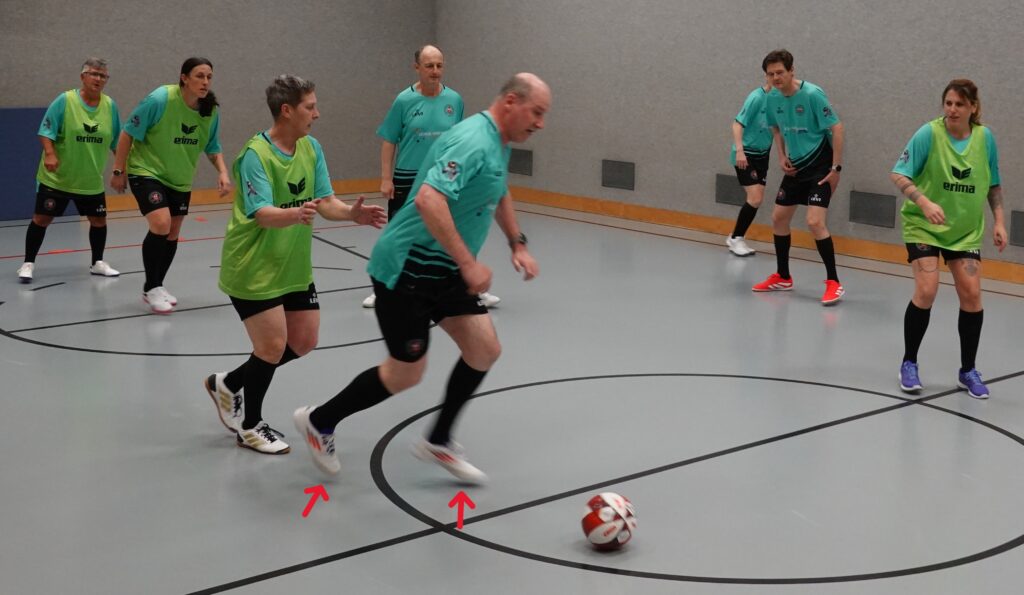
The picture opposite shows the correct way to play: each team member has at least one foot in contact with the ground!
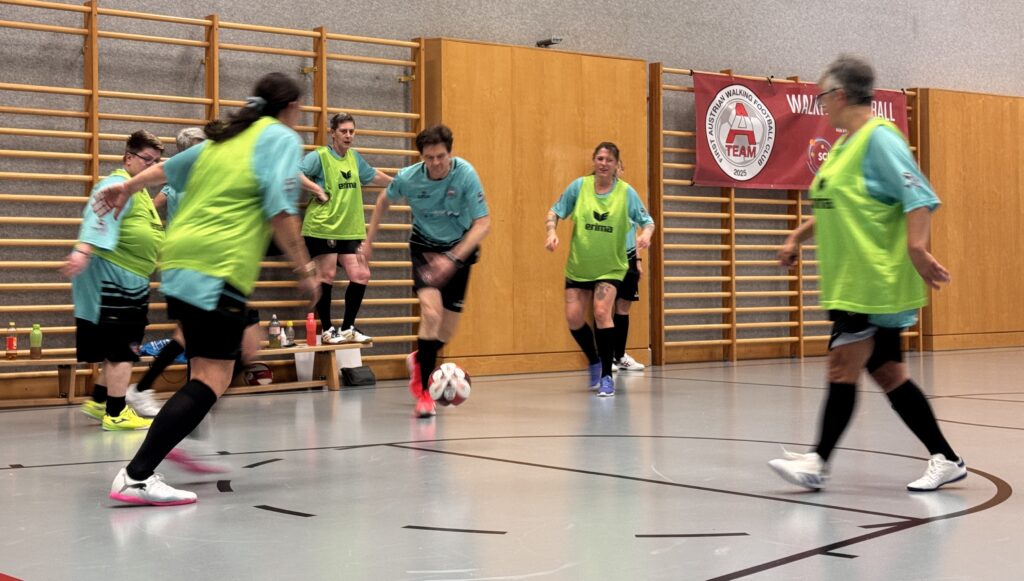
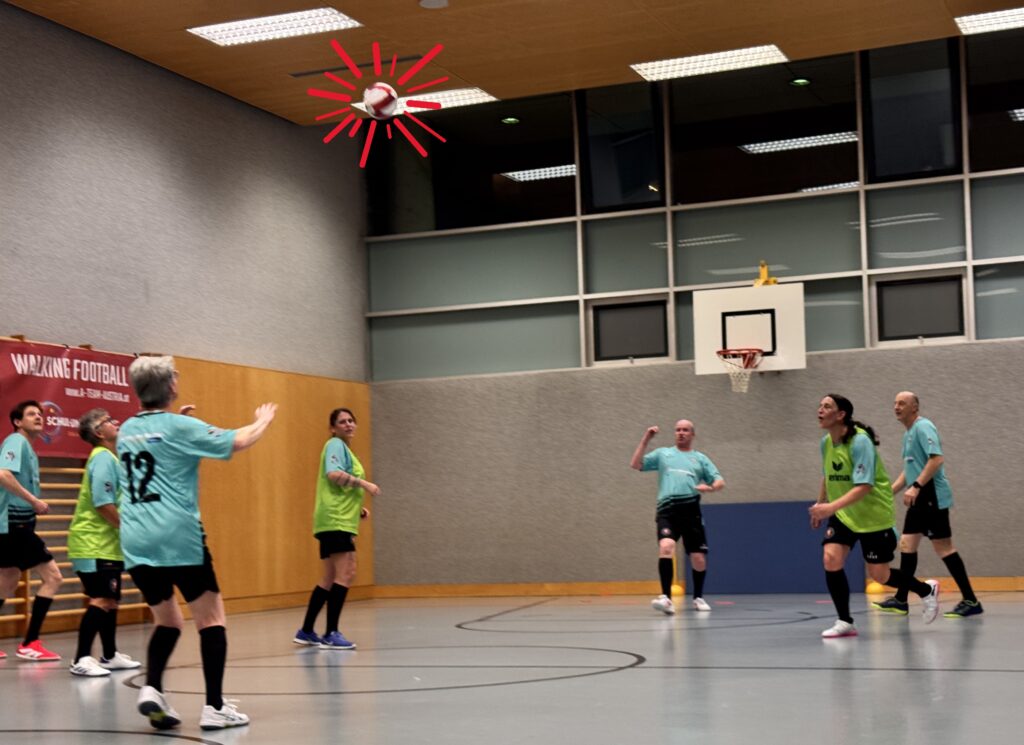
The ball has to be kept flat.
If the ball is played over a height of 1 metre, as shown in this photo, the opposing team is awarded a free kick at the spot where the ball was last played.
If a player gets shot and the ball goes over the permitted height, a free kick is awarded to the opposing team from the spot of the offence.
Physical contact in general and straddling, tackling, pushing or shoving of opponents in particular are prohibited and will be penalized with a free kick.
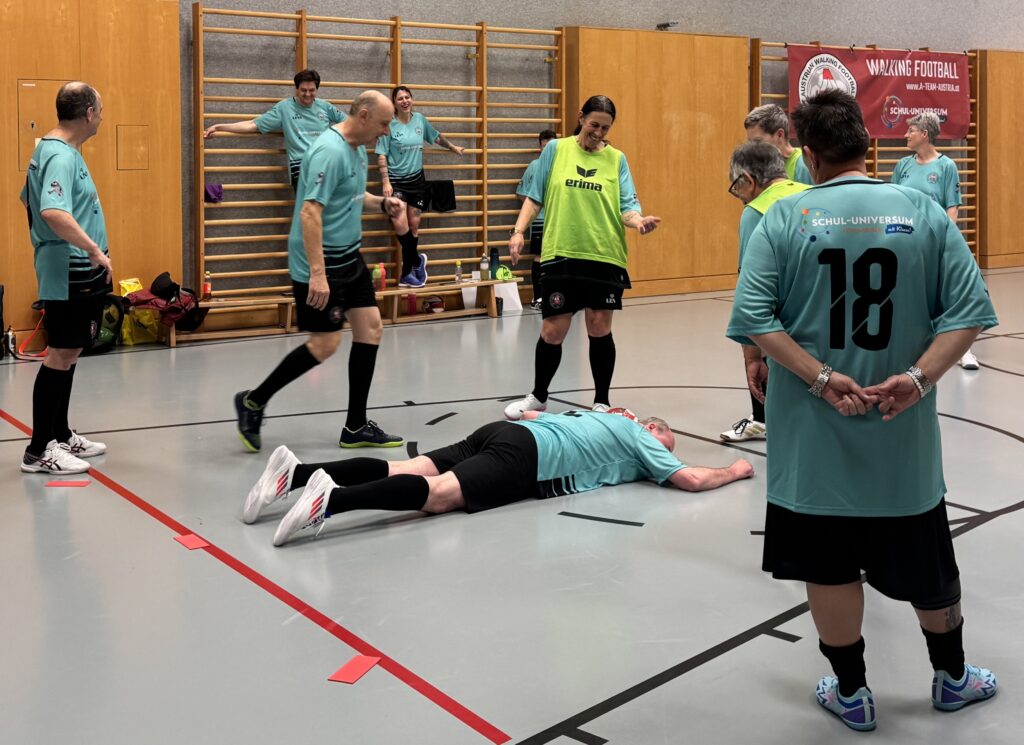
If a player falls through his own fault or the fault of a third party, the game is ‘frozen’ until the fallen player gives the OK to continue play.
Substitutions are possible at any time and are made on the fly in the team’s own half at the centre line.
There is no offside rule.
If the ball goes out over the touchline, it is not thrown in but played with the foot.
The ball may be played through the goal area. If the ball is unintentionally left in the goal area, the defending team gains possession and may play the ball from the goal area line. Goal kicks are to be taken in front of this line..
None of the players may remain in the goal area (neither standing nor running through). There is no penalty for unintentionally entering the goal area without gaining an advantage. Unintentional entry into the goal area where the ball is played, without a goal being scored, is penalized with a free kick. Goals scored inside the goal area are disallowed and the defending team is awarded a free kick. If a goal is thwarted in the goal area by the defending team, a penalty kick is awarded.
The penalty kick is passed by a player at the corner flag to his/her team-mate behind the halfway line. After crossing the ball from the centre line, the player may shoot the ball behind the centre line directly into the empty goal. Only two players of one team are on the field during the execution of the free kick.
No direct goal can be scored from a free kick. All free kicks are indirect. The distance for free kicks, corner kicks and kick-ins is three metres. If the distance to the goal is so small that the defending team would have to stand ‘on the goal line’, the referee will change the location.
Goals scored from the own half do not count. Play continues with a goal kick.
It is possible to score directly from a corner kick.
Own goals count from the whole pitch.